
National Study Day Reflections 2025
This year’s National Study Day was held on the 7th of June and we all read Paper 101, The Real Nature of Religion. Several groups around the country met face-to-face and from their reports—which you can read below—indicate that this paper generated much deep thought and discussion (as it always does).
Here are some reflections:
Canberra Study Group
(Report by William Wentworth)
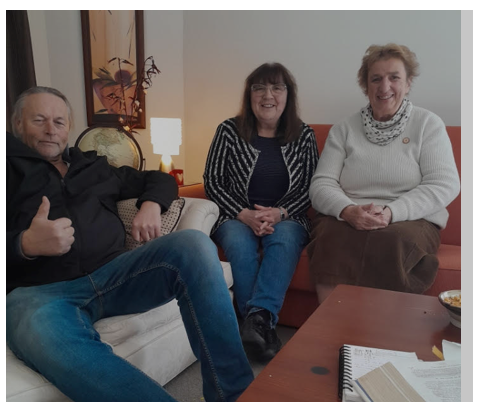
We met at 2.30pm on Saturday, 7th June. Present were Dylan Roberts, Nigel Nunn, Vern Verass and William Wentworth
We began to read the paper and almost immediately began a discussion about the difference between the inspiration of man’s evolving nature and its secret. This took some time although no firm conclusions were reached.
Then in the following paragraph “the contradictory logic of despair” generated discussion which also took some time.
Then in Section 1 the first paragraph about reason and religion generated many personal anecdotes related to the topic.
The following paragraphs pointing out that thoughts—not feelings—are the substance of religious experience also generated discussion and anecdotes. There was agreement that “to doubt God or to distrust his goodness would be to prove untrue to the realest and deepest thing within the human mind and soul—the divine Adjuster”.
Section 2—the Fact of Religion also generated much discussion about the techniques of science, religion and philosophy and the significance of revelation. We all had different experiences to relate.
We took note of the 12 characteristics of genuine spiritual faith with few comments, but
Section 4—The Limitations of Revelation—led to much discussion as we know that this is the subject of great controversy among the scientific readership.
By this time, we discovered that we had spent so much time in discussion and the relation of personal experiences that time had expired, and we were quite unable to finish the paper.
Paper 101 is a fascinating paper, but we would need much more time to do it justice. Even so, we had a most enjoyable afternoon.
Sydney Study Group
(Report by Daniel Swadling)
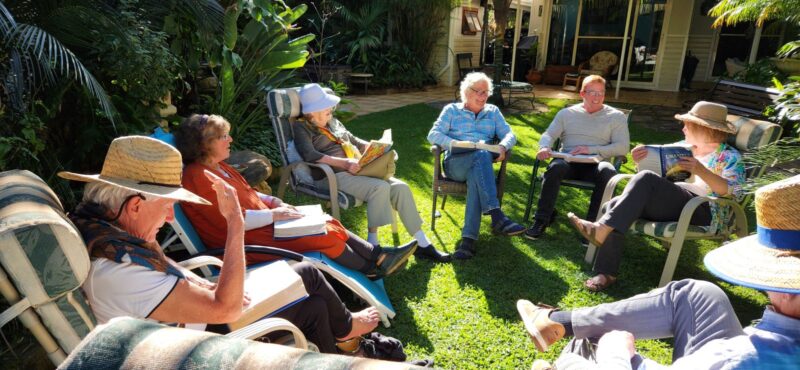
Another fine gathering of friendship and study held at the Swadling’s in Mona Vale, bringing together groups from across Sydney, the Central Coast and Newcastle. It was one of those spectacular clear winter days Sydney puts on, so donning our hats and sunglasses we all sat outside in the bright sun. And so the reading and study proceeded with our hearts and minds lifted and clarified by the brilliance of the day.
What a contrast the Paper was to the ease of the company and the day! Very challenging material and yet very rewarding. Much discussion was stimulated, many new insights gained, and as always ideas and encouragement for further reflection and study.
So what did we learn from this insightful and useful paper? Its aim is to convey what religion is: it provides a breakdown of its core components and shows why it’s vitally important to us as individuals. Increasingly, people in the world today reject religion really because they don’t understand what it truly is or why they need it. Or they don’t want to have anything to do with the traditional religions of the world with their strange customs, superstitions, contradictions and irrational, sometimes unkind beliefs. This paper is a clarification and expansion of what religion actually is.
Rather than authorising creeds, beliefs, traditions, and guidelines on how to think, feel and behave in our lives, we learn from these teachings that true religion fundamentally and simply is an experience, a personal experience of faith, trust and assurance. Distinction is made between concepts we use to describe a person: a) you, your personality, b) your mind, which you use, c) your physical body, in which you currently reside, and d) your soul, which evolves as you grow spiritually. The right ‘location’ of religious experience is with a) you, your personality: religion is more than an emotional feeling and it transcends mind. It is not something that can be reasoned or proved intellectually (in mind) and is not a mystical feeling of ecstasy (in body). You experience the divine through your thoughts in the conduit of your mind, which is described as ‘spiritual insight.’ Religious experience is ‘a profoundly deep and actual experience of spiritual communion with the spirit influences resident within the human mind.’ (101:1.4) It is the personal human experience of divine, eternal realities, and such ongoing religious experiences lead to increased certainty of God and assurance of your survival after death.
The section on ‘The Characteristics of Religion’ induced much discussion and inspiration in our group today. We learned that if we truly have religious faith as a genuine personal experience, then will we present and demonstrate in our lives such characteristics as those listed (and more) when confronted with the tests and trials of everyday living. (101:3.4-16) We were reminded of the ‘inevitabilities’ – the desirability of courage, altruism, hope, faith, love of truth, idealism, loyalty, unselfishness, and pleasure, requiring us to face the difficulties and vicissitudes of life in order to acquire them. (3:5.5-14) And also the ‘fruits of the spirit’ presented and demonstrated in the lives of those who are genuinely ‘born of the spirit of truth-seeking and God-finding,’ ‘who, by faith, become, in deed and in truth, the everlasting sons of the eternal God.’ (193:2.2) We liked the point that these characteristics are proof that people hold a divine spirit within them. (101:3.17) If we can only strive to manifest them in our lives…phew!
Another interesting distinction made by the paper was between evolved and revealed religion. Evolved religion is mainly concerned with human duty, ethics and morals, that helps with the stabilisation of civilisations, is derived from mind, and depends wholly on faith. Revealed religion expands upon this, is derived from spirit, and is fundamentally concerned with truth, and loving, the personal duty of living the golden rule. The experience of the functional union of the two, faith and truth, constitutes a person who is developing their soul, that is, experiencing spiritual growth. (101:5.10-12)
The description of the pathway of spiritual progression is a very insightful guide. From its inception through gaining knowledge, wisdom and truth, and growth through moral decisions, embracing of high ideals and the building of a righteous character and moral personality: the prerequisites for entry into the increasingly spiritual morontia phase. We particularly enjoyed the unpacking of ‘salvation’ into seven types, and the fact that all lead to spiritual perfection and are ‘contained within the reality of the faith of the human experience of religion.’ (101:6.16) Which is crucially connected to how we live our life as states of mind and beliefs only become faith when they dominate and shape the way we live. ‘Belief fixates, faith liberates.’ (101:8.2)
And thus, ‘Faith becomes the connection between moral consciousness and the spiritual concept of enduring reality. Religion becomes the avenue of man’s escape from the material limitations of the temporal and natural world to the supernal realities of the eternal and spiritual world by and through the technique of salvation, the progressive morontia transformation.’ (101:9.9)
What a great note to end the study on as we understood then that religion, when appreciated in this way, is liberating! It is only through spiritual insight, faith, that we can ever break free from mortality. We can only discover the divine through religious experience and by true faith. (101:10.4) And when we are transformed by faith, we are no longer a slave to the mechanical universe, but a liberated spiritual son of God. (101:10.8)
Melbourne Study Group
(Report by “The Melbournites”)
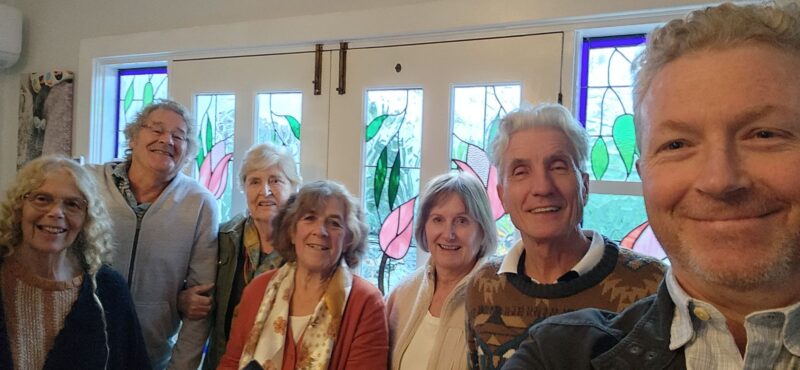
The year is 2025 and already and the National Study Day arrived yet again so soon. The Paper 101 – The Real Nature Of Religion was chosen. We asked ourselves, What IS religion and the three passages of the introduction said it all and engendered a lot of discussion amongst us:
Religion, the conviction-faith of the personality, can always triumph over the superficially contradictory logic of despair born in the unbelieving material mind. There reality is a true and genuine inner voice, that, “true light which lights every man who comes into the world.” And this spirit leading is distinct from the ethical prompting of human conscience. The feeling of religious assurance is more than an emotional feeling. The assurance of religion transcends the reason of the mind, even the logic of philosophy. Religion is faith, trust and assurance. 101:0.3 (1104.3)
Then there is the incredible parade of the content chapters:
1. True Religion
2. The Fact of Religion
3. The Characteristics of Religion
4. The Limitations of Revelation
5. Religion Expanded by Revelation
6. Progressive Religious Experience
7. A Personal Philosophy of Religion
8. Faith and Belief
9. Religion and morality
10. Religion as Man’s Liberator
That’s an impressive list!
True religion is not a system of philosophic belief… is not the product of reason… is not derived from the logic of human philosophy. Religion is the experiencing of divinity in the consciousness of a moral being of evolutionary origin; it represents experience with eternal realities in time, the realization of spiritual satisfactions while yet in the flesh. 101:1.1 (1104.4 )
The divine spirit makes contact with mortal man, not by feelings or emotions, but in the of the highest and most spiritualised thinking. It is your thoughts, not your feelings, that lead you Godward. The divine nature may be perceived only with the eyes of the mind. But the mind that really discerns God, hears the indwelling Adjuster, is pure mind. “Without holiness no man may see the Lord.” All such inner and spiritual communion is termed spiritual insight. Such religious experiences result from the impress made upon the mind of man by the combined operations of the Adjuster and the Spirit of Truth as they function amid and upon the ideas, ideals, insights, and spirit strivings of the evolving Sons of God. 101:1.3 (1104.6)
Studying Urantia Book is such a wonderful experience, and our lives are changed forever. Every Study Day makes meeting with a special group of friends a celebration. We go to lunch afterwards and it’s like having an extension to the meeting, where of course we talk more about the paper just studied. It feels a bit like the Wedding at Cana with lots of guests in a full Restaurant.
Thank you Heavenly Father for the opportunity to participate in this eternal adventure. “Our Father, who is in heaven, hallowed be your name, your kingdom come, your will be done on Urantia—Michael’s bestowal planet—as it is in heaven.” Amen.